From Semantic Networks to Rhizomatic Maps
Bridging the Gap Between AI Efficiency and Human Insight

Hello and welcome.
In my previous post, we explored the idea of Webbing – the shift from rigid boundaries toward an expansive, interconnected network of meaning. Today, I want to deepen that conversation by looking at a challenge we all face: the rise of Artificial Intelligence in our creative and research processes.
In my latest paper, recently published in the AMPS Conference Proceedings following a lecture in Prague, I discuss how we can maintain human sense-making in an age of automated data.
The Trap of the “Semantic Shortcut”
We are increasingly told that AI-driven tools can overcome human limitations in managing complexity. These platforms excel at building semantic networks: visual maps of established relationships derived from statistical patterns in vast datasets.
But there is a catch. AI largely operates within textual and statistical boundaries. It can identify that “A” often appears with “B,” but it struggles to capture the contextual nuances, the ambiguities, and the sensory inspirations – the physical touch of a material, the silence in an interview, private inspirations – that lead to truly original design.
When we lean too heavily on these automated outputs, we risk falling into a “synthesis shortcut.” We get results that feel familiar because they are built on what has already been said.
Rhizomatic Mapping: Prompting Yourself
Rhizomatic mapping offers a different path. It is a methodology that prioritizes human intuition and creative synthesis over rigid, automated hierarchies. Instead of letting a language model define the relationships for you, you become the weaver.
In the paper, I highlight how this works through the practice of my former students at Bezalel Academy of Arts and Design:
Dafna Noam used a rhizomatic map to connect materials science with user rituals, eventually reconceiving the paintbrush not just as a tool, but as a “living,” renewable object where the fibers themselves form the handle.
Oded Friedland approached a 3,700-year-old archaeological mystery, the Megiddo Bowl, by mapping speculative functions that transformed an ancient artifact into a modern design investigation.
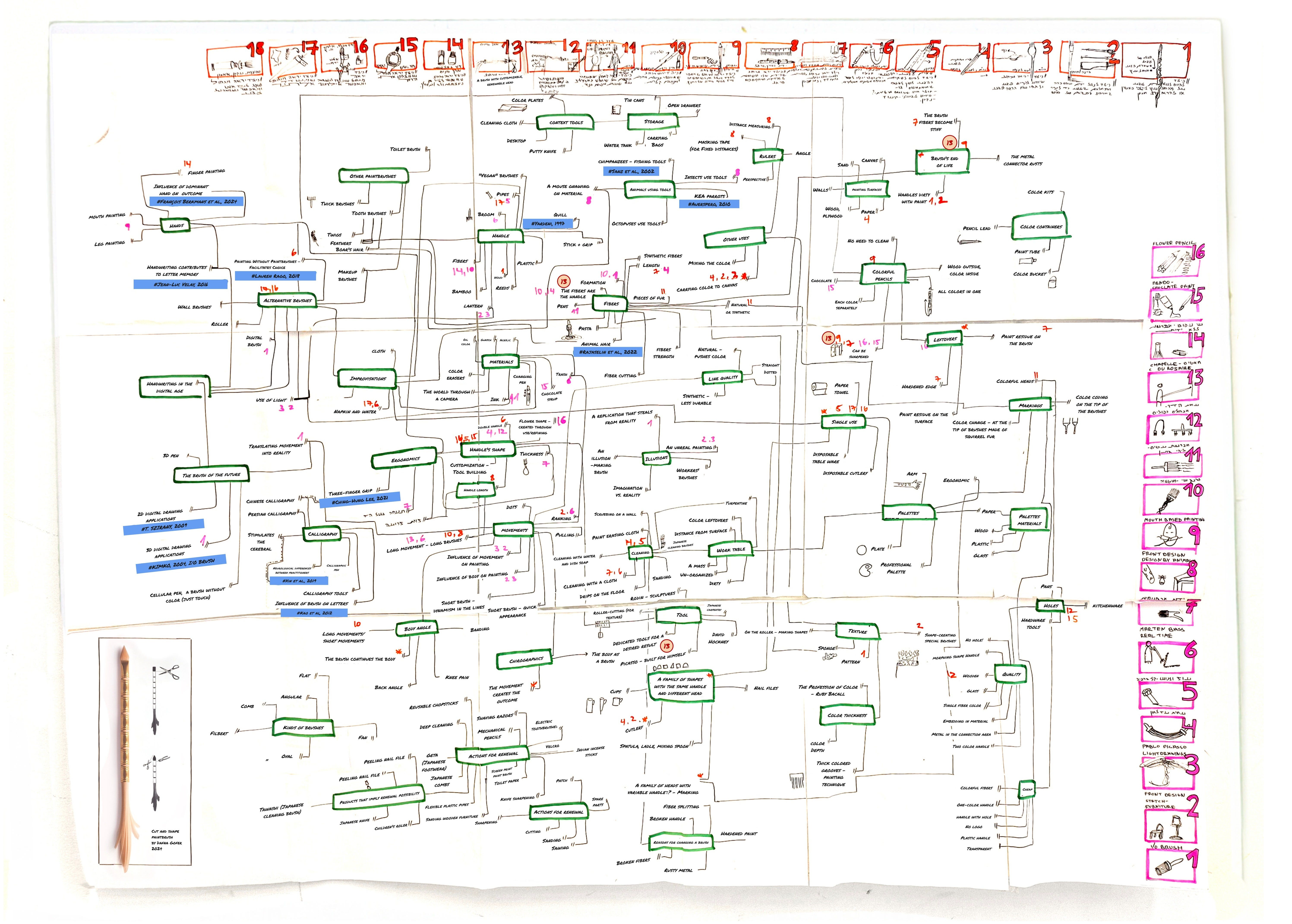
Dafna Gofer’s rhizomatic map of paintbrush research, 2025
AI as a Backstage Companion
This doesn’t mean we must discard AI. Rather, we should use it as a “backstage companion”. In my sessions, I teach how to use AI for what it’s best at—retrieving data—while reserving the vital act of contextual interpretation and synchronization for the human designer.
By “prompting ourselves” to find non-trivial connections between distant domains, we move from problem-solving to sense-making. We turn research into an evolving landscape rather than a path toward a fixed conclusion.
In a world where AI can give us an immediate, familiar answer, our ability to contain ambiguity and forge unpredictable links is our greatest competitive advantage.
Read the full research > If you’d like to dive into the technical formalization of this method and the full analysis of these case studies, you can download the complete paper here: https://www.academia.edu/164429489/Rhizomatic_Mapping_in_Design_Research_A_Creative_Methodology_for_Visual_Inquiry_and_Pedagogical_Practice
Curious to explore rhizomatic mapping further?
I offer short talks and hands-on workshops (online or in-person) tailored to your questions, field, and context. It is a space that lets you explore how these tools can serve the creative process rather than leading it. You can find more details at rhizomaticmapping.com.
Thanks for reading!
Ravid Rovner PhD
Discussion about this post