Mapping Without a Center
From Hierarchical Frameworks to Generative Peripheries

Many ways of mapping knowledge begin with a center. But what if thinking could begin anywhere?
Hello and welcome.
This post continues the exploration that began with Webbing, Not Framing! and continued with From Semantic Networks to Rhizomatic Maps. It examines a familiar habit in research – starting from a center – and explores what becomes possible when any element can serve as a point of entry, and significance emerges through relations.
In many mapping practices, thinking begins from a clearly defined center.
This way of structuring knowledge has become so familiar that it often goes unquestioned.
The center feels reassuring. It promises orientation, clarity, and control. It suggests that thinking begins from a stable point and proceeds outward in an orderly way.
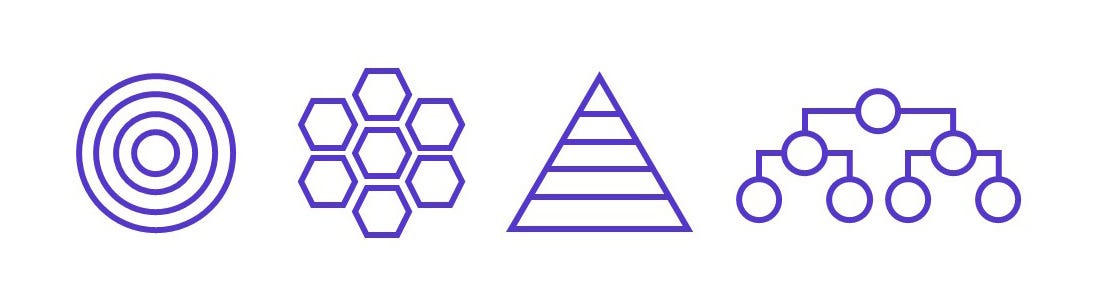
Examples of hierarchical structures: the center–periphery model, the honeycomb model, the hierarchical pyramid, and branching diagrams. Image: Ravid Rovner, 2026
Working from a center or fixed base assumes that a main idea is already in place. The task then becomes dividing it into parts and subdividing those parts further. As the structure grows, its center of gravity remains fixed. Everything ultimately points back to the same origin.
In many contexts, this approach is useful. It helps organize existing knowledge and communicate established frameworks.
In exploratory and creative research, however, starting from a center quietly shapes what can emerge. Attention gathers around what is already known. Elements placed farther away appear less significant. Peripheral observations are easier to overlook, even when they carry unexpected creative potential.
Rhizomatic mapping offers another way to enter the process.
Instead of beginning with a central idea, any element can serve as a point of entry: a concept, an image, a fragment of data, or a note taken in passing. What matters is not where the map starts, but how relations begin to form.
Because a rhizomatic map is non-hierarchical, no single element governs the structure. Items are positioned in relation to what is already present, guided by conceptual proximity rather than rank.
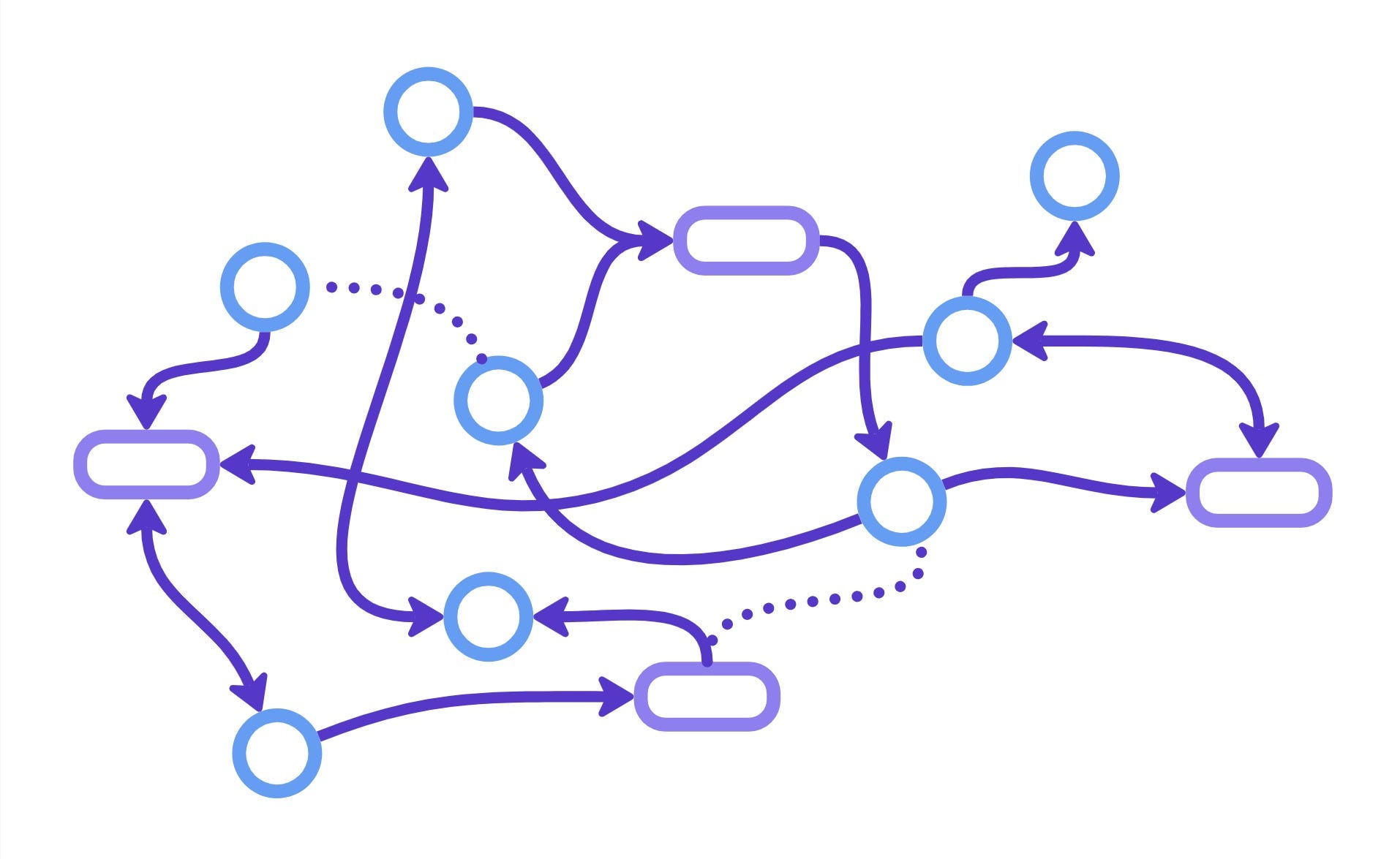
An illustration of a rhizomatic map. The structure emerges through positioning and connecting items. Image: Ravid Rovner, 2026
Without a center, the map develops as a surface of relations. Meaning forms through adjacency, color schemes, and connections. An observation added early may resonate with a reference introduced much later. What appears marginal at one moment can become active at another. In this sense, the periphery is only temporal.
In creative research, this openness is especially valuable.
As the map grows in multiple directions at once, rhizomatic mapping supports a mode of thinking that stays receptive to surprise.
Gradually, some areas of the map become dense with items and connections, while others remain sparse, inviting further exploration. As the map thickens with interconnected knowledge, an innovative concept, thesis, or idea begins to emerge.
So next time you start researching, try leaving the center empty. Begin anywhere. Let relations guide the structure instead of the other way around.
The map’s peripheries might become its innovative power.
Curious to explore rhizomatic mapping further?
I offer short talks and hands-on workshops (online or in-person) tailored to your questions, field, and context. You can find more details at rhizomaticmapping.com.
Thanks for reading!
Ravid Rovner PhD
Discussion about this post