

Hello and welcome.
For many years, rhizomatic mapping was just something I did. There was no method behind it. I didn't even call it rhizomatic mapping – it was simply how I kept track of what I was learning and saw my own thoughts about it. Looking back I see how a private habit slowly became something others could use too. Here's the story of why and how it happened.
Back in 2005, I was a design student. I studied industrial design and was deeply intrigued by the research part of the design process. In a second-year class, we were introduced to Tony Buzan’s “mind maps.” You probably know them: you place the topic at the center and then draw “branches” around, write a sub-topic on each, and continue to dissect them into ever-thinner branches. In the lesson, Buzan’s maps were shown as a way to organize our design research.
I remember looking at the examples and feeling uncomfortable. Something about this “tree” structure just felt flat and simplistic. I went back home that day and decided to try it myself, to test if mind mapping worked for me or not.
The small research I was working on back then was paintbrushes. I tried to organize what I already knew in this predetermined structure. I placed the theme “Paintbrushes” at the center of an A4 paper. Then I created the branches – production techniques, user experiences, things colored by hand, sizes and measures, ergonomics…. As I was going through the obvious, there were some items which just didn’t fit in one branch, if at all.
One such item was the movie scene from Karate Kid (1984), where Mr. Miyagi instructs Daniel LaRusso to paint his fence “up-and-down!”. LaRusso later realizes the repetitive wrist motions built his muscle memory for a defensive karate move. So, to which branch did this scene belong? I contemplated while looking at my mind map. Certainly not (only) “things colored by hand” (fences). The brush served as a secret teaching method through a physical embodiment process. And it suggested that an everyday object could discipline us.
The Buzanian mind map just didn’t help. Yes, it can open paths, but it makes you stay in them, always leading further from the center. And worse, it limits you to attaching each thing to one branch only. Miyagi’s brush just cannot.
So, I started placing my items all over the paper and connecting them to each other. Miyagi’s brush was connected to repetitive movement, wrist pain, learning by doing, and to fences. When my map was full of nodes and connections, I switched into ideation mode. I connected repetitive movement and wrist pain to “lack of adjustability” (which I observed by looking at users), and replaceable accessories (a derivate of paint rollers). I ended up designing a very cool handle that can be mounted on any brush to change its angle by 35 degrees, as I discovered it reduces wrist pain. I screened the scene from the movie during my products’ presentation.
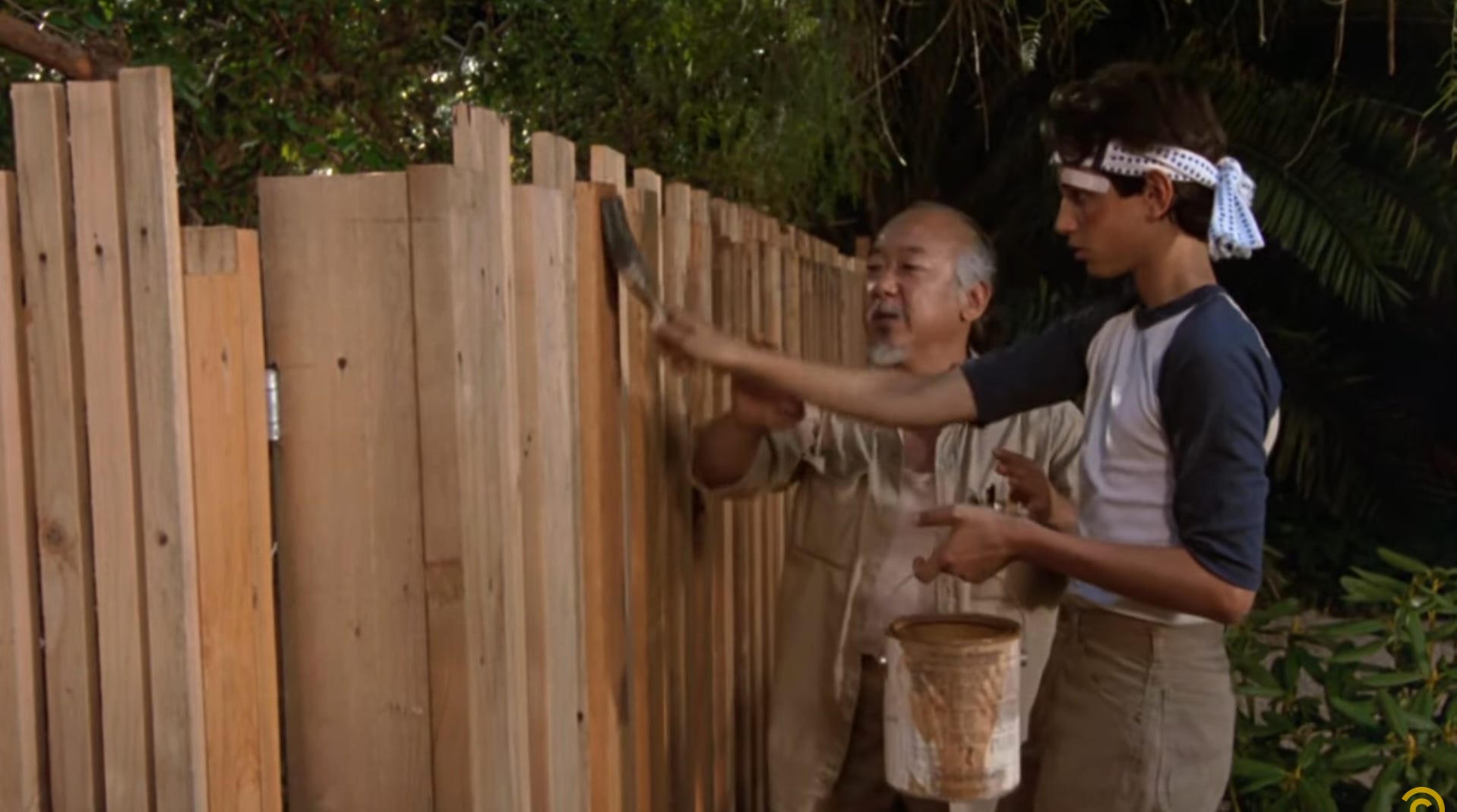
Mr. Miyagi instructs Daniel LaRusso to paint his fence “up-and-down!” in Karate Kid (1984).
I didn’t keep my maps from that time. Some of them, including the brush one, were inside my sketchbooks, which I threw away as I became a digital nomad. Yes, I was into discarding whatever wasn’t necessary and going minimal.
After finishing my bachelor’s, I started studying for a master’s in philosophy. The shift from creative-visual studies to abstract-textual studies came with an academic cost. I had to complete the bridging program, which amounted to half a bachelor’s degree, and take a Philosophy Proficiency Test. It’s a hard one, covering nine canonical books.
This is when my mapping process became crucial. I was living back then in a small apartment of two rooms, still packed with sketches and models from my previous academic life. My plan was to study really fast, so I could start my master’s parallel to finishing the bridging program. Basically, I had a month for it, and back then I knew just half of the books on the list.
I got my color pencils sharpened, glued a few A4s together, and dived in. I read and mapped each of the books on the list, transferring its core concepts and ideas into nodes and connecting them with lines and arrows.
Three weeks of intensive mapping, and my small living room was covered with nine maps hanging on the walls. I could see whole books spread in front of my eyes. Here, Kant’s metaphysics; there, Nietzsche’s political thought. The reaction of friends who came to visit me then was “Wow.” Quite a wall covering.
During the proficiency test, whenever I needed information, I simply closed my eyes and traveled on the right map to find it. Keeping the maps didn’t seem important back then. I considered them an intuitive and natural way to learn – like others did with their written summaries – so when I got a good grade and started my master’s, I just threw them away.
This changed when I started creating maps with my own thoughts. They contained inquiries into questions that bothered me then: Is real translation possible? How did the aesthetics of national flags evolve? Why was statistics formed as a science? Is philosophy dead? Alongside the information I gathered from reading, I mapped my insights, hesitations, and directions for future inquiries. I then extracted my main claims and supporting quotes for my seminar essays.
Soon after, I was asked to become a teaching assistant. I was to teach the discussion section attached to Prof. Ruth Weintraub’s course on Epistemological Skepticism in TAU. I decided to put my maps to educational use.
I created a map for my student that showed “Responses to Skepticism.” It contained the core epistemological stances – foundationalism, coherentism, contextualism, reliabilism – the philosophers who discussed them, and further explanations. It was 2010. I mapped it in VUE, a predecessor of apps like Miro and Figma. I loved the outcome and sent it to Prof. Weintraub.
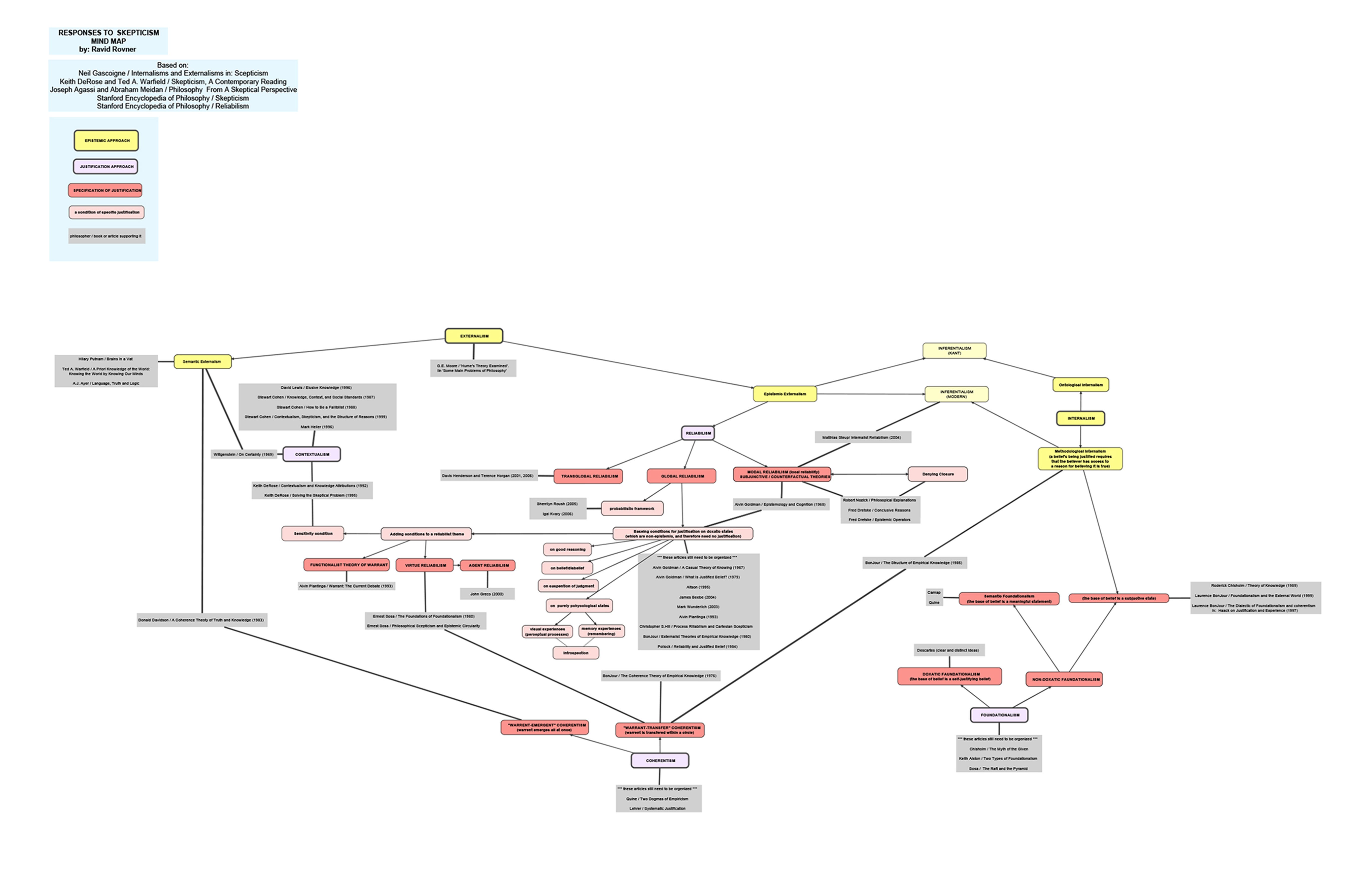
Responses to Skepticism map, 2010 - the full version, before Prof. Weintraub asked me to trim it. Made in VUE, an ancestor of today’s Miro and Figma.
In our email exchange, she approved only a slimmer version – just the texts we’d actually discuss. I didn’t understand it. Why not give students the larger map, so they could reach for more? I didn’t say anything, but I thought she was being overly cautious.
While completing my master’s, I was asked by the design faculty at HIT – my former academic home – to teach an annual course on the “History of Design.” The catch: 230 students from three departments (industrial design, interior design, and visual communication), plus the semester was about to begin in four months.
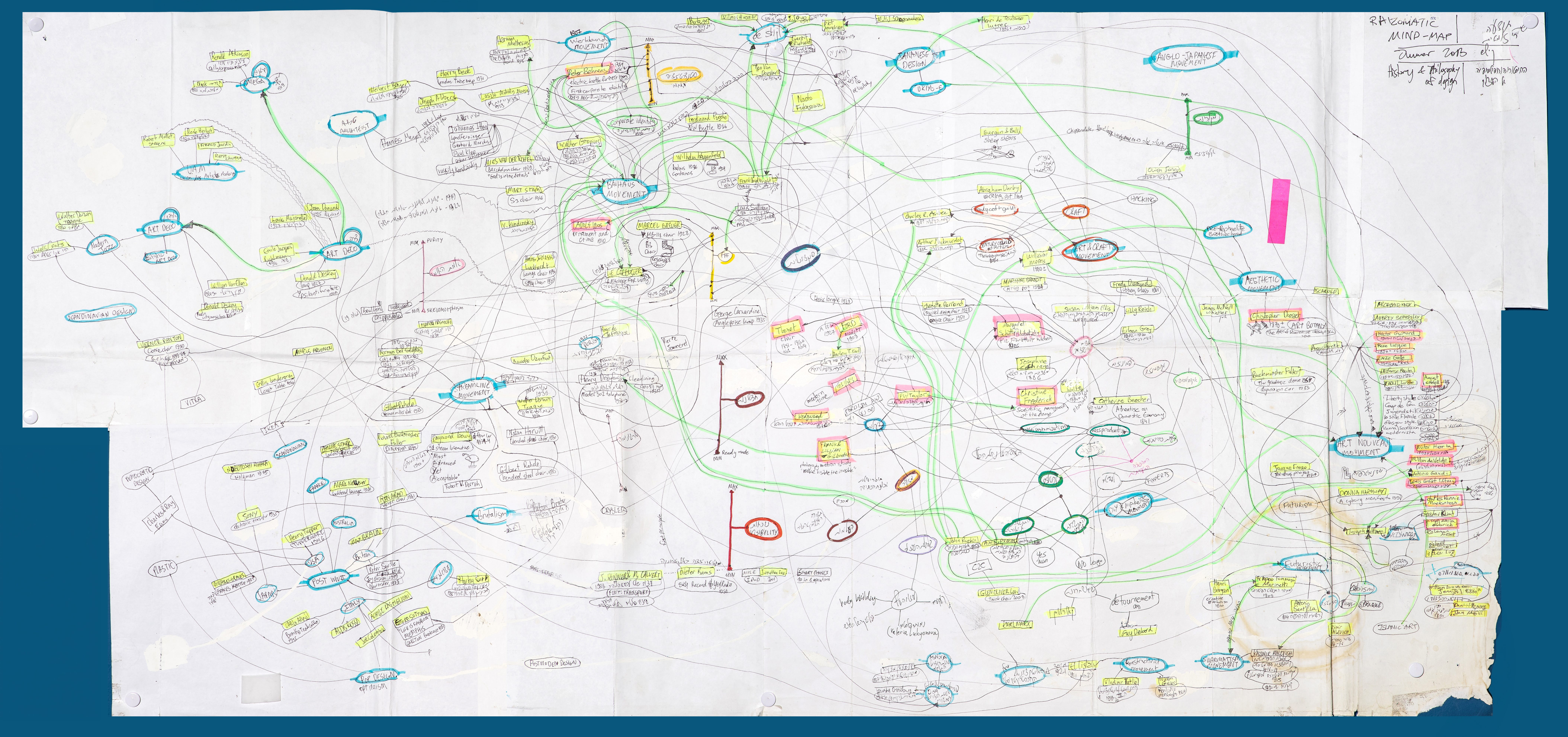
The History of Design map, 2013. Hand-drawn. Designers, movements, and principles placed by how they relate, not when they occurred. I still show it in every talk.
The map I produced for the course was one I cherish. I always show it when I give my talks and workshops. It’s a historical map but has nothing linear or chronological about it. I mapped the field of knowledge to understand how designers, design movements and design principles relate to each other across time and place. The map made me realize I want to teach the evolution of modern design’s core concepts: functionality, universality, efficiency, simplicity and truth to materials.
I thought it would be an awesome idea to give the map to my students. This time, I had no one to stop me! I mapped the base of knowledge I planned to teach, uploaded the PDF to the courses’ database and revealed it to my students in the first lesson.
Ah, the alarmed faces. The squeaking chairs, the low murmur. The end-of-course feedback was good, but on one point the students were unanimous: the map had made them feel, from day one, that the course would be impossible to grasp.
Weintraub had been right. Immediate exposure to complexity doesn’t invite people in and might even shut them out. It was a strange thing to learn: the map that helps you think isn’t always what would help others. Knowledge has to be built up gradually, even when you (as the educator) have a whole structure already mapped out. I continued teaching this course without revealing the back map. I’m still teaching it, 13 years later.
This could have been the end of using my maps as a teaching device. But, in 2019 I was given the opportunity to present my maps in a mini-solo exhibition in “Vitrina,” the academy’s gallery. It was the first time that my maps were shown on an official stage to the wider public. I presented six maps, including the two courses’ map – paper and digitalized version – and yes, I still have them today.
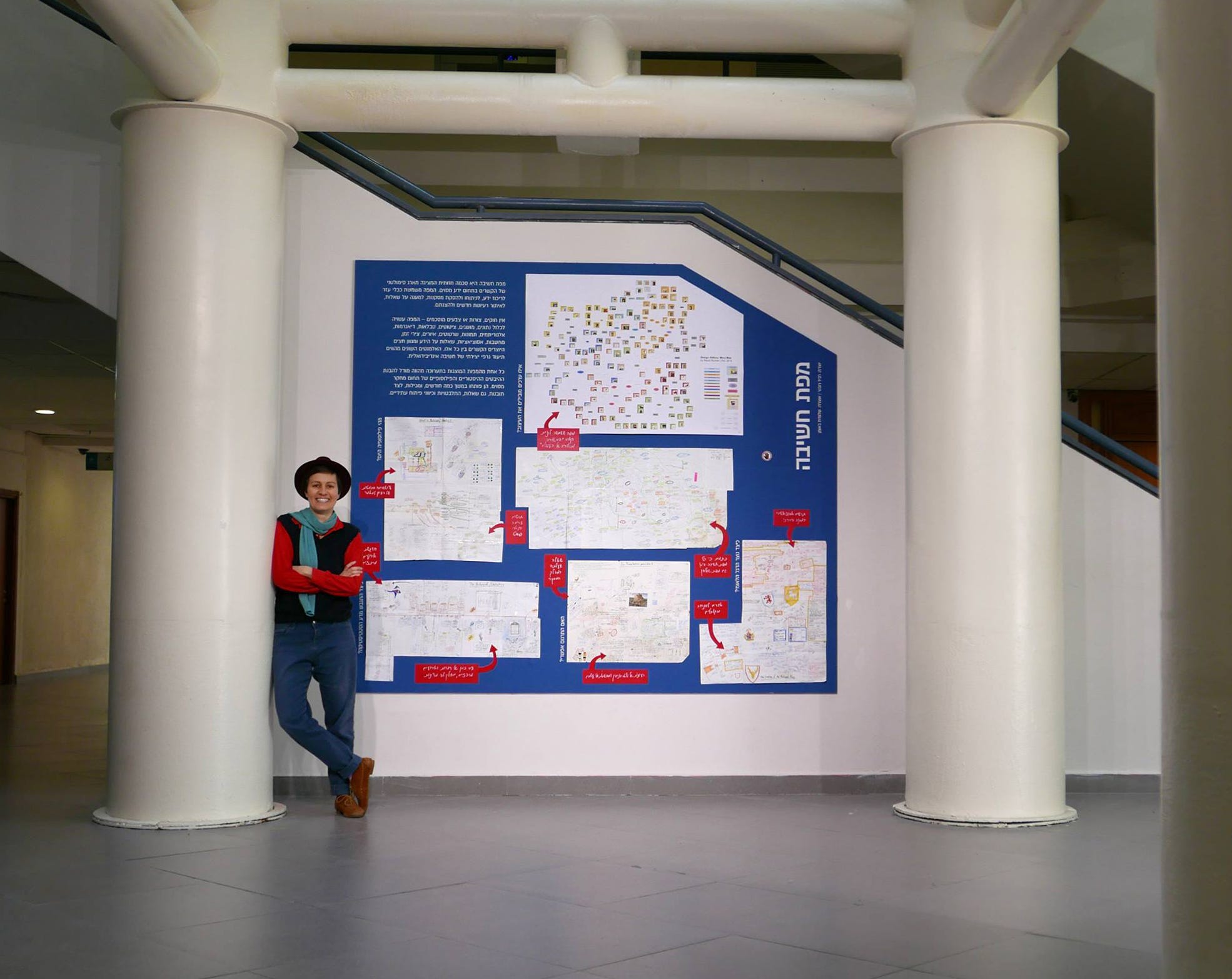
At my mini-solo show in the Vitrina Gallery, 2019. It was the first time the maps met the public. Curated by Shlomit Bauman.
This small exhibition brought a second exposure and a big challenge. I was invited to give a lecture on my mapping technique at a conference about design research at the Bezalel Academy of Art and Design and was asked to accompany it with a workshop.
A workshop!
Showing and talking about what I do was easy. But teaching others how to do it was a whole different story. To me, my method was idiosyncratic – I didn’t think of it as something that can be taught. But I decided to give it a try.
I brought several magazine articles to the session, and I explained to the few participants how to transfer the text to a map. Today, this amounts to a fraction of what Rhizomatic mapping can do.
Back then, I still didn’t even call it “rhizomatic mapping.” I simply called it “mind mapping,” though I knew that the term was already taken. In fact, I had the idea that my maps were real mind maps, while Buzan’s were just a technical organization procedure, like putting files into folders. How naïve I was to think that I could reclaim the term!
Soon I figured out that it was impossible, and that I’d have to find another name. I came across Deleuze and Guattari’s “Rhizome” around that time and was amazed. They described a de-centered, non-hierarchical, growing in all-directions roots-of-grass like web. It is like I’ve been visualizing their abstract concept all along. “Rhizomatic mapping” as a term was born in 2019, alongside my first paper “Rhizomatic Mind Maps as a Form of Design Thinking” (notice how I still insisted on the “mind”).
Same year, I started teaching this method to design students in both Bezalel and Shenkar College of Engineering, Design and Art. My challenge was to shift the method from mapping a theoretical inquiry into mapping a design inquiry. Design research combines theory with physical-visual aspects and user research. And, most importantly, aims at ideating new designs. I had to figure out how to use the rhizomatic map to jump from theory to praxis: from Miyagi’s brush to an ergonomic brush handle.
It took a few years to refine, during which I designed the process for both singular and collaborative mapping from research to ideation. I tested the application of my method in workshops to non-designers too: curators, entrepreneurs, artists, social reformers, and others. I also utilized it for personal career counseling. I sit one-on-one with people who are on a quest for their professional future, mapping together their past and exploring new prospects. Rhizomatic mapping has already helped hundreds of people to think, organize, and ideate.
Twenty years after my first map, I don’t throw away my maps anymore. I collect mine and research others to find out how the map of rhizomatic mapping can expand further.
If you make maps like these, or feel the pull to start, I’d genuinely like to see them. I review readers’ rhizomatic maps and publish selected ones here with my commentary; you can send me yours.
And if you’d like to explore how rhizomatic mapping might work for your own thinking, you’ll find my talks, workshops, and one-on-one sessions at rhizomaticmapping.com.
Thanks for reading!
Ravid Rovner PhD