

If AI can assemble the perfect research paper, how can educators ensure learning actually took place?
Hello and welcome.
In previous posts, I explored the theoretical shift from Webbing to Framing and the role of AI as a Backstage Companion in research. Today, I want to take these ideas out of the abstract and into the classroom.
We are currently witnessing a quiet crisis in education. Teachers, from primary schools to universities, are struggling with the ubiquity of generative AI. Essays and homework assignments are routinely automated, leaving educators unable to distinguish student output from machine synthesis.
While crude hallucinations and fake citations will eventually disappear as Large Language Models evolve, the greater loss is the process of research itself: the time, the deep attention, the critique, and the constant rewriting.
In response, some educators are retreating to pen-and-paper exams. While understandable, this Luddite reaction is a step backward; a time-constrained exam can only test memory and basic comprehension, not the deep, expansive labor of actual research.
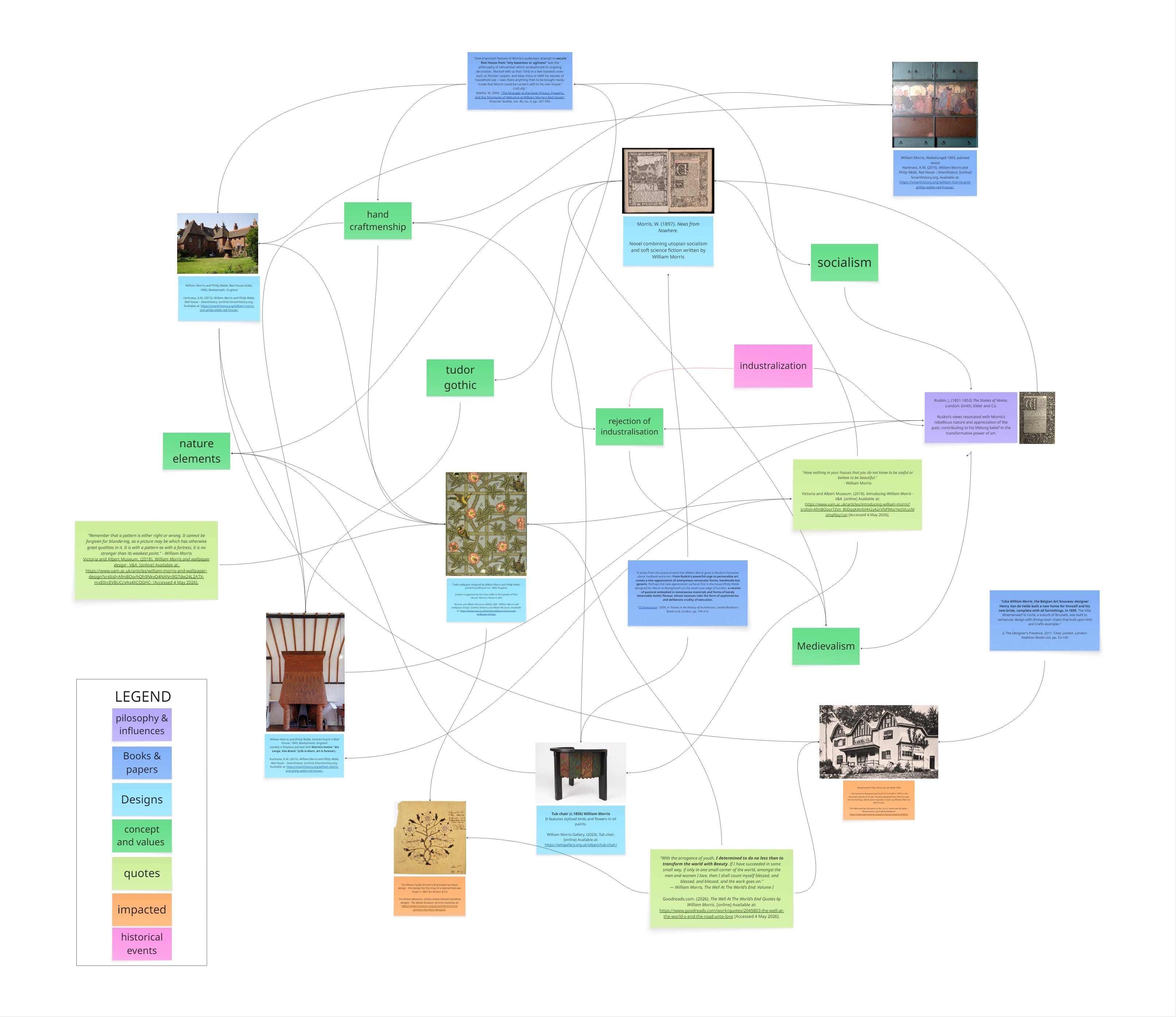
Rhizomatic map exploring the visual DNA, socio-political context, and shifting design ideologies of William Morris, by Alexandra Lappo and Klara Stec, 2026.
The Calculator Fallacy
When defending generative AI in the classroom, people often look to history: “In the 1960s and 1970s, math educators resisted the electronic calculator, fearing it would stunt arithmetic intuition. Isn’t rejecting AI today the same thing?”
The answer is yes and no.
There is a fundamental difference between mathematical calculation and abstract, critical thinking. Arithmetic is a technical execution; it seeks a single, predetermined correct answer. Writing a research essay, however, requires a free connectivity of ideas, evaluation, contrast, and critique. It demands that students trace complex events across contexts, understand how they shape the present, and imagine alternative futures.
Established researchers who use AI already know how to navigate this landscape; they know how to think, critique, and write, so they easily understand where an automated input adds value and where it flattens the research. For today’s students, however, outsourcing the synthesis makes the entire mental effort feel redundant.
By letting a machine handle this core synthesis, we are actively numbing human cognitive capabilities. Moreover, we limit the inquiry to what the machine statistically already knows. Because AI prioritizes averages, it traps us within an automated consensus, leaving virtually no room for truly original thought.
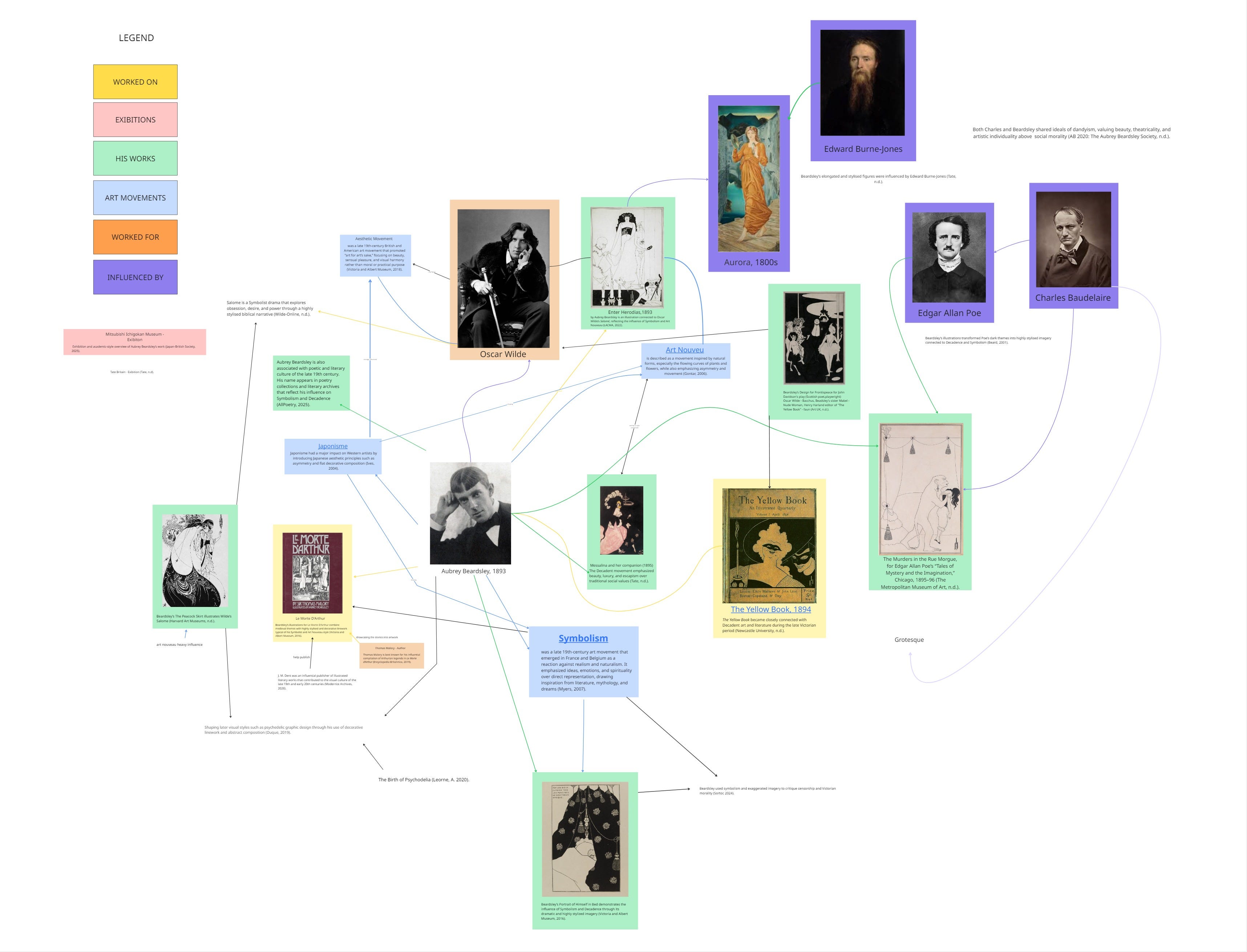
A collaborative rhizomatic map tracing the intricate cultural influences, literary connections, and aesthetic work of Aubrey Beardsley by Ana Tsekovska, Eva Trajkovska, and Katerina Petrova, 2026.
The Thessaloniki Experiment
Faced with this challenge, I wanted to find a pedagogical solution that protects human thinking without ignoring technological reality.
This past semester at AAS College (Applied Arts Studies) in Thessaloniki, I taught a course on research and writing in the history of design to 15 international students across visual communication, interior design, and animation. My goal was dual: deliver historical context through lectures and discussions, and evaluate their research through an entirely restructured assessment model.
The final grade relied on two tightly integrated assignments:
The Designer’s World on a Rhizomatic Map: Students had to map their chosen designer’s world on a digital Miro board, synchronizing historical events, ideologies, cultural influences, major works, and personal reflections.
Critical Research Essay: A formal paper (1,800–2,200 words) articulating a narrative of the exact connections they visually showed on their maps.
Throughout the semester, the students built their maps gradually on Miro. They could see each other's maps growing in real time, which sparked a healthy, constructive classroom competition to see whose network of knowledge becomes the richest. To ground the practice, I mapped my own concurrent research on designer Louise Brigham alongside them, showing them hands-on how a non-linear network expands.
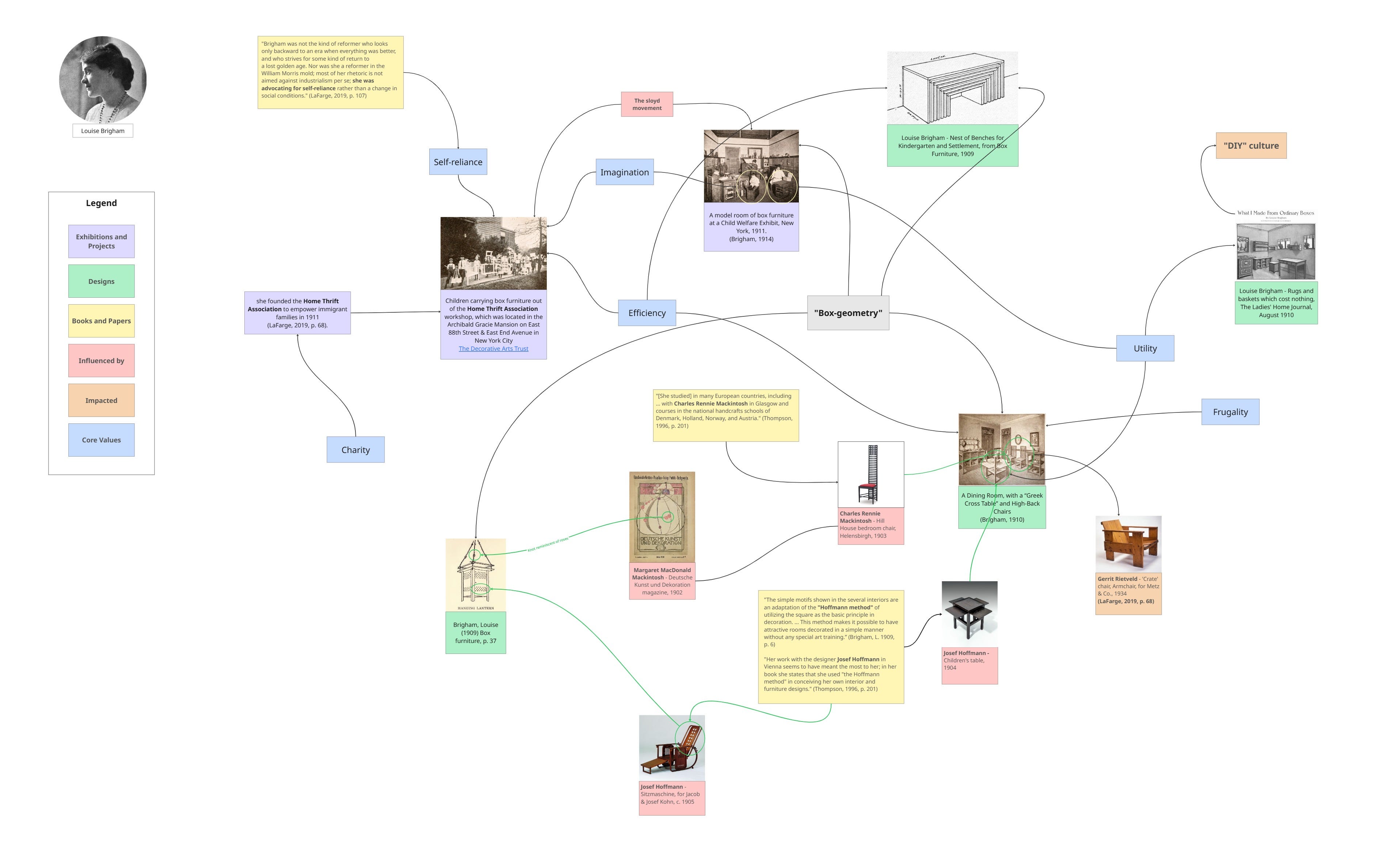
An example of a rhizomatic map created for research on the designer Louise Brigham, used to demonstrate the methodology to students by Ravid Rovner, 2026.
Why You Cannot Lie with a Map
The core revelation of this experiment is simple: you cannot lie with a rhizomatic map.
A student can easily use AI to retrieve data or locate sources. But when it comes to the map, the machine cannot do the heavy lifting. The student must physically place the node, categorize its information type (Is it a product? A core value? A semantic feature?), and draw the connector to another node. They must explicitly decide the nature of that relationship: Is this cross-pollination, or is it direct cause and effect?
In short, they are forced to think.
Furthermore, every historical node added to the map had to be explicitly backed by a scholarly reference (books, papers, or exhibition catalogues). Because the map served as a visual database of their own making, the hardest part of the essay was already solved before they wrote a single sentence. The map held the data; the essay articulated the story.
What the Students Learned (and Felt)
The results of the final essays were typical of any cohort - some were brilliant, others were more basic. But the critical victory was undeniable: every single essay was authentically written by the student. The prose had voice, rhythm, and structural quirks that mirrored the exact visual architecture of their maps.
To get a sense of their experience, I conducted an anonymous student survey immediately following their map presentations:
On discovering connections: The vast majority noted that the mapping process helped them discover non-obvious links to a great extent.
On deep research: One student reflected: “The rhizomatic map was useful to see movements and context. … it helped me concentrate and research deeper on a specific artist.”
On overcoming AI dependence: Most profoundly, another student wrote: “In today’s world since AI exists it’s quite hard to not use it, but this way I proved it otherwise... I mainly used AI [in high school] as it was so easy to be guided, but I proved myself again that it’s better to research on my own, so thank you.”
Reflections for the Future
The experiment was a success, but it also revealed a fascinating pedagogical glitch.
During the oral presentations, the non-hierarchical nature of the maps allowed students to flow too freely from one interesting point to another. The narrative lacked a clear path. In future cohorts, I plan to introduce a second layer to the map: a narrative route. After building the web, students will literally draw a sequential line threading through the nodes, directing a viewer from the opening argument to the conclusion.
By prioritizing the map before the text, we turn research back into an active, human experience. We show students that navigating complexity is where original thought actually begins.
Have you tried introducing visual or non-linear frameworks into your own teaching or research workflows to balance the pull of automated tools? I’d love to hear your thoughts in the comments.
Curious to explore rhizomatic mapping further?
I offer short talks and hands-on workshops (online or in-person) tailored to your questions, field, and context. You can find more details at rhizomaticmapping.com.
Thanks for reading!
Ravid Rovner PhD